
Docker vs Podman in 2026 — Which Should You Use on a VPS?
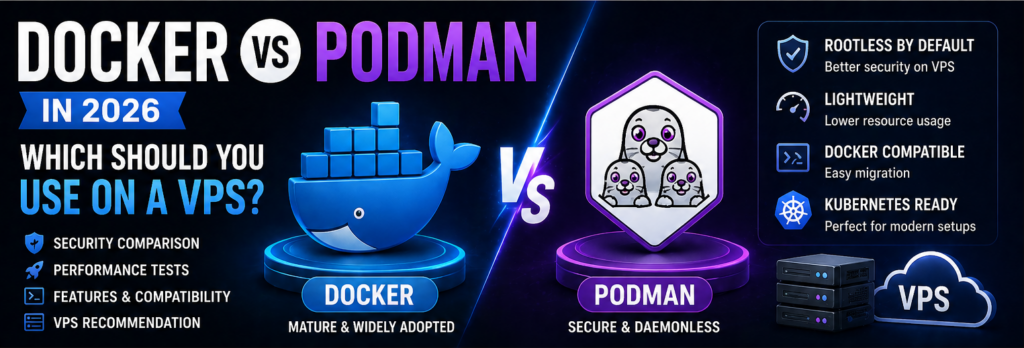
Containers have become the backbone of modern application deployment. Whether you're running a simple web app or a complex microservices architecture, containerization makes everything easier, faster, and more scalable.
For years, Docker has been the dominant player in this space. But recently, Podman has emerged as a strong alternative, especially for users focused on security and rootless operation.
So the big question in 2026 is:
👉 Should you use Docker or Podman on your VPS?
This guide breaks it down in detail — not just theory, but real-world usage, performance, security, and practical recommendations.
What is Docker?
Docker is a platform that allows you to build, ship, and run applications in containers.
Key features:
- Easy to use
- Huge ecosystem
- Strong community support
- Widely adopted
What is Podman?
Podman is a container engine developed by Red Hat that is designed as a drop-in replacement for Docker.
Key features:
- Daemonless architecture
- Rootless containers by default
- Better security model
Core Architecture Difference
Docker Architecture
Docker uses a daemon-based model:
- Docker daemon runs as root
- All containers managed by it
👉 Downside: single point of failure + security risk
Podman Architecture
Podman is daemonless:
- No background service
- Each container runs independently
👉 More secure and flexible
Docker vs Podman: Key Differences
| Feature | Docker | Podman |
|---|---|---|
| Architecture | Daemon-based | Daemonless |
| Rootless Support | Available (manual) | Native |
| Security | Moderate | Strong |
| CLI Compatibility | Standard | Docker-compatible |
| Kubernetes Integration | Good | Better alignment |
Ease of Use
Docker
- Beginner-friendly
- Tons of tutorials
- Easy installation
Podman
- Slight learning curve
- But Docker CLI compatible
Example:
docker run nginx
podman run nginx
👉 Almost identical
Performance Comparison
Startup Time
- Docker: Slight overhead due to daemon
- Podman: Faster startup
Resource Usage
- Docker: Uses daemon resources
- Podman: Lightweight
Security Comparison
This is where Podman shines.
Docker Security
- Runs daemon as root
- Risk if daemon compromised
Podman Security
- Rootless by default
- No central daemon
- Better isolation
👉 Ideal for VPS environments
Rootless Containers
Podman was built for rootless from the start.
Docker supports rootless but:
- Requires additional setup
- Not default
Networking Differences
Docker
- Uses Docker network
- Centralized management
Podman
- Uses CNI plugins
- More flexible
Kubernetes Compatibility
Podman integrates well with Kubernetes workflows.
Docker support is still strong but less aligned with modern Kubernetes architecture.
Ecosystem & Community
Docker
- Massive ecosystem
- Docker Hub
- Enterprise tools
Podman
- Growing rapidly
- Backed by Red Hat
Real-World Use Cases
Use Docker If:
- You are a beginner
- You want simplicity
- You rely on Docker ecosystem
Use Podman If:
- You prioritize security
- You want rootless containers
- You run production workloads
VPS Recommendation
For VPS users:
👉 Podman is often the better choice in 2026
Why?
- Better security
- No root requirement
- Lightweight
Migration from Docker to Podman
Easy migration:
alias docker=podman
Common Mistakes
- Ignoring security
- Running everything as root
- Not understanding container isolation
Best Practices
- Use rootless containers
- Limit privileges
- Monitor containers
- Use minimal images
FAQs
Is Podman replacing Docker?
Not completely, but gaining popularity.
Can I use both?
Yes.
Final Thoughts
Docker is still dominant, but Podman is catching up fast — especially in security-focused environments.
👉 For VPS users in 2026, Podman is a strong, future-proof choice.