
GitOps vs Traditional DevOps — What’s the Difference?
DevOps has transformed how software is built and deployed. But as systems grew more complex, even DevOps started facing limitations.
GitOps emerged as the next evolution.
But what exactly is the difference between GitOps and traditional DevOps?
In this guide, we’ll break it down in simple terms.
What is DevOps?
DevOps is a culture and practice that combines:
- Development
- Operations
It focuses on:
- Automation
- Collaboration
- Continuous delivery
What is GitOps?
GitOps is a subset of DevOps that uses Git as the central control system.
Key Differences
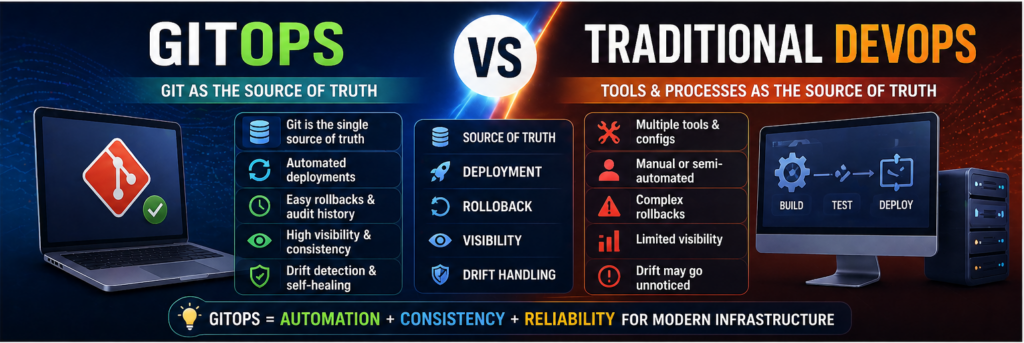
| Feature | DevOps | GitOps |
|---|---|---|
| Source of Truth | Tools + configs | Git |
| Deployment | Manual/automated | Fully automated |
| Rollbacks | Complex | Easy |
| Visibility | Limited | High |
Deployment Approach
DevOps
- Scripts
- CI/CD tools
- Manual triggers
GitOps
- Git commits trigger deployments
- Fully automated
Benefits of GitOps Over DevOps
- Better traceability
- Easier rollbacks
- Improved consistency
When to Use DevOps
- Simple applications
- Small teams
When to Use GitOps
- Kubernetes environments
- Large-scale systems
Real-World Example
DevOps
Engineer runs deployment script.
GitOps
Engineer commits to Git → system deploys automatically.
Pros and Cons
DevOps Pros
- Flexible
- Mature ecosystem
Cons
- Can be inconsistent
GitOps Pros
- Automated
- Reliable
Cons
- Learning curve
Best Approach
👉 Combine both
Future of GitOps
GitOps is rapidly becoming the standard for cloud-native deployments.
FAQs
Is GitOps replacing DevOps?
No, it extends DevOps.
Which is better?
Depends on use case.
Final Thoughts
GitOps brings structure, automation, and reliability to modern deployments. Understanding both approaches helps you choose the right strategy.