
What is AIOps? Beginner’s Guide to AI in IT Operations
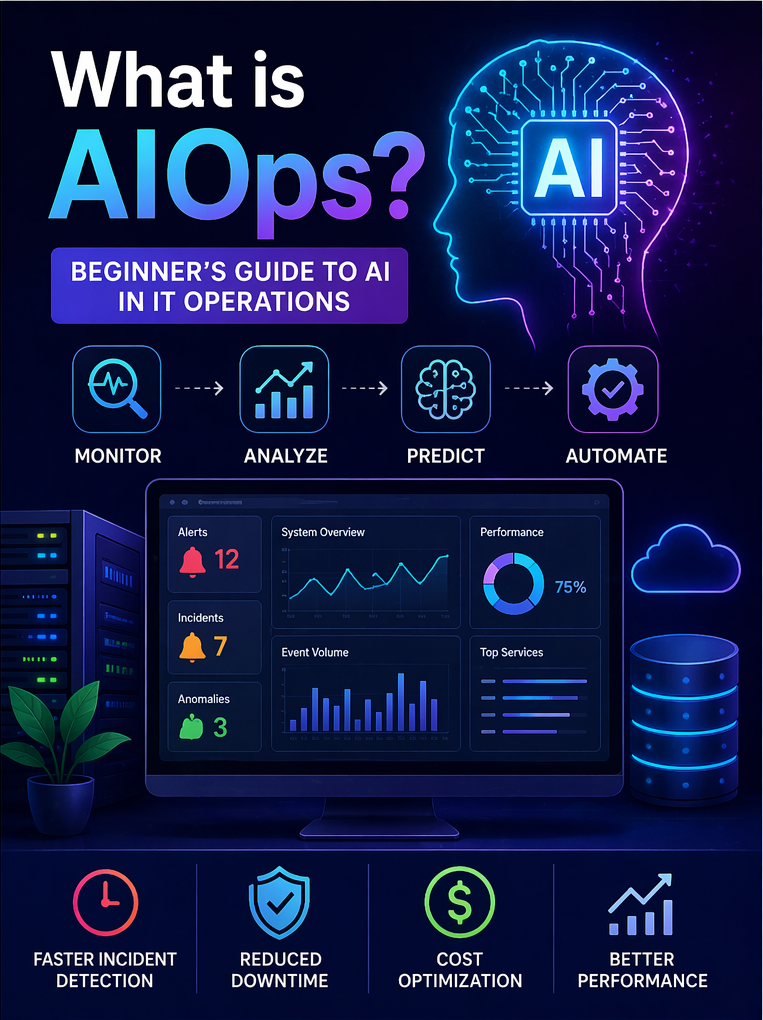
Modern IT infrastructure is more complex than ever. With cloud computing, microservices, and distributed systems, managing operations manually is becoming nearly impossible.
This is where AIOps comes in.
AIOps (Artificial Intelligence for IT Operations) uses machine learning and data analysis to automate and improve IT operations.
In this guide, you’ll learn:
- What AIOps is
- How it works
- Benefits and use cases
- Tools and real-world examples
What is AIOps?
AIOps stands for:
👉 Artificial Intelligence for IT Operations
It combines:
- Machine learning
- Big data
- Automation
To monitor and manage IT systems.
Why AIOps is Important
Traditional IT operations struggle with:
- Huge volumes of data
- Complex environments
- Slow incident response
AIOps solves this by:
- Automating analysis
- Detecting anomalies
- Predicting issues
How AIOps Works
Step 1: Data Collection
Collect logs, metrics, events.
Step 2: Data Processing
Analyze using machine learning.
Step 3: Pattern Detection
Identify normal vs abnormal behavior.
Step 4: Automation
Trigger actions automatically.
Key Components of AIOps
- Data ingestion
- Analytics engine
- Machine learning models
- Automation workflows
Benefits of AIOps
1. Faster Incident Detection
Identify problems instantly.
2. Reduced Downtime
Fix issues before they impact users.
3. Cost Optimization
Use resources efficiently.
4. Improved Performance
Optimize infrastructure automatically.
AIOps vs Traditional Monitoring
| Feature | Traditional | AIOps |
|---|---|---|
| Monitoring | Reactive | Proactive |
| Analysis | Manual | Automated |
| Speed | Slow | Fast |
Real-World Use Cases
1. Cloud Infrastructure Monitoring
Detect anomalies in AWS/Azure.
2. Application Performance Monitoring
Identify slow services.
3. Security Threat Detection
Spot unusual activity.
Popular AIOps Tools
Some commonly used tools include:
- Dynatrace
- Splunk
- Datadog
AIOps in DevOps
AIOps complements DevOps by:
- Automating monitoring
- Improving CI/CD pipelines
- Reducing manual work
Challenges of AIOps
- Requires quality data
- Initial setup complexity
- Learning curve
Best Practices
- Start small
- Use reliable data sources
- Monitor results
Future of AIOps
AIOps is expected to:
- Become standard in IT
- Reduce manual operations
- Improve automation
FAQs
Is AIOps only for large companies?
No, even small setups can benefit.
Does AIOps replace DevOps?
No, it enhances it.
Final Thoughts
AIOps is transforming how IT operations are managed. If you want to stay ahead in DevOps and cloud computing, understanding AIOps is essential.