
Serverless vs Traditional Deployment — Pros, Cons & Demo
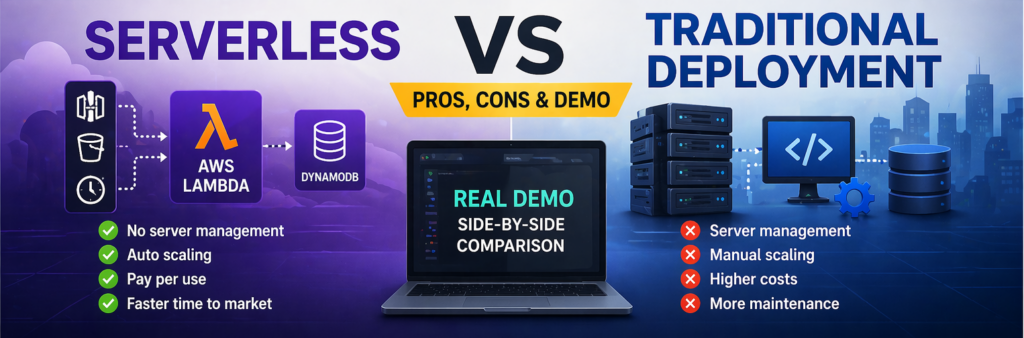
Choosing between serverless and traditional deployment is one of the biggest decisions in modern application architecture.
Should you:
- Use serverless platforms like AWS Lambda?
- Or manage your own servers and infrastructure?
Each approach has its strengths and weaknesses.
In this guide, we compare serverless vs traditional deployment in detail, with real-world examples and practical insights.
What is Serverless Deployment?
Serverless means you don’t manage servers.
Example:
- AWS Lambda
- Cloud Functions
You deploy code, and the cloud provider runs it.
What is Traditional Deployment?
Traditional deployment means:
- Managing servers
- Installing software
- Handling scaling manually
Key Differences
| Feature | Serverless | Traditional |
|---|---|---|
| Server Management | None | Required |
| Scaling | Automatic | Manual |
| Cost | Pay per use | Fixed |
| Control | Limited | Full |
Pros of Serverless
1. No Server Management
No maintenance required.
2. Auto Scaling
Handles traffic spikes.
3. Cost Efficient
Pay only when used.
Cons of Serverless
1. Cold Starts
Initial delay.
2. Vendor Lock-in
Dependent on cloud provider.
Pros of Traditional Deployment
1. Full Control
Customize everything.
2. Predictable Performance
No cold starts.
Cons of Traditional Deployment
1. Maintenance Overhead
You manage everything.
2. Scaling Complexity
Requires planning.
Real-World Demo Comparison
Scenario: Simple API
Serverless
- Deploy on AWS Lambda
- Auto scaling
Traditional
- Deploy on VPS
- Configure Nginx
Cost Comparison
Serverless:
- Cheap for low traffic
Traditional:
- Better for constant load
Performance Comparison
Serverless:
- Slight delay (cold start)
Traditional:
- Consistent performance
When to Use Serverless
- Event-driven apps
- Low traffic apps
- Rapid development
When to Use Traditional
- High traffic apps
- Long-running processes
- Full control needed
Hybrid Approach
Many companies use both:
- Serverless for APIs
- Traditional for core services
Best Practices
- Choose based on use case
- Monitor costs
- Optimize architecture
FAQs
Which is cheaper?
Depends on usage.
Which is faster?
Traditional for consistent load.
Final Thoughts
There is no one-size-fits-all answer. The best approach depends on your workload, budget, and scaling needs.